Onam
Onam ഓണം, the foremost festival among the cultural repertoire of Malayalees, falls in the harvest season of August- September. The festival is primarily celebrated in Kerala, a state in India, by people across all caste and religions.
Chingam or Bhadrapada, the first month of the calendar ushers in Onam, the national festival of Kerala. After the rain drenched Karkidakam with its privations, Chingam is a welcome month of plenty. The sky becomes blue, the deep forest becomes greener and it is time to reap the harvest, time to celebrate and to rejoice along with the Nature. And Onam epitomizes the newfound vigour and enthusiasm about everything around. It is celebrated with traditional Malayalee fervour with visit to temples, family get-togethers, gifting each other clothes called Ona-kkodi and lots of merry making.
This picturesque ten-day harvest festival has been part of Malayalee psyche for centuries now. There are records of Onam being celebrated during the Sangam Age. Onam festivities have been recorded during the time of Kulasekhara Perumals around A.D 800. It is believed that during those days the whole of Chingam was celebrated as Onam season.
Onam - Onam legend
Kashyapa had two wives, Diti and Aditi, who were the parents of demons and demigods (Asuras and Devas) respectively. As the common practice in those days, for a King invading another kingdom to acquire additional territory, Indra, the king of demigods went on war with the king of Asuras. Mahabali, the King of Asuras defeated Indra and proceed to occupy Indra's territory. Kashyapa, who had gone to the Himalayas to do penance, on his return, found Aditi weeping over the defeat of her son, Indra. By divine insight, Kashyapa recognised the cause of grief. Kashyapa tried to console Aditi who was wailing in grief, saying that nothing happens in the world wihtout God's will and people should go on doing their duties. Kashyapa asked Aditi to pray to Lord Narayana and taught her Payovrata, ritual that has to be observed from the twelfth day of the bright half Karthika (Sukla-paksha Dwaadasi). Since Aditi carried out the Vrata with a pious heart, Lord Narayana appeared before her and informed her that he would himself take birth in her womb and help Indra. Later, on the twelfth day of the bright half of the month of Bhadrapada, Aditi gave birth to a son of uncommon effulgence. That child, "Vamana-murti", demonstrated His divine powers by doing marvelous deeds even when He was a child.
Balichakravarthi (Bali, The Emperor) or Mahabali, was the grandson of the devout Prahalada, the son of Hiranyakasipu. Bali, like Prahlada, too engaged in the glorification of God and in the spiritual and material uplife of his subjects. Mahabali who was performing the sacrificial rite called Viswajith declared that he would give anything that anyone sought from him during this Yagna. Bali wanted to propitiate the Gods so much that, with their blessings, he could extend his beneficent rule over the entire world. Lord Narayan, in the form of Vamana, utilised this opportunity to shower Grace on him.
Vamana came to the Yaga-shala. As he was approaching them, the sages assembled there perceived the extraordinary effulgence form of the young lad. Mahabali went forth to receive the Brahmin boy with all traditional honours and gave him an eminent seat befitting the status of a holy person. Bali told him 'Master! It is my good fortune that you have chosen to honour me with your presence. Whatever you desire, I am here ready to fulfil the same'. Vamana smiled and said: "You need not give me anything great. It is enough if you give me that extend of land covered by three footsteps of mine".
On hearing him, Bali's preceptor, Shukracharya, who could have vision of the future told Bali that the one, who had come to seed a gift from Bali was not an ordinary Brahmin but Lord Narayana Himself who had assumed this form. He advised Bali not to promise the lad anything. But Bali was a king who would never go back on his word and told his Guru that he would never break his promise. He was determined to give Vamana whatever he wanted since breaking one's word was a sin and he had to keep his pledge Shukracharya insisted that he should not fulfil the demand of Vamana as he had come to deprive Bali of all His possessions. He said that Vamana was not really in need of anything as everything was in his hands.
Bali, however, was determined to honour the word given to Vamana, begged pardon of his Guru for disregarding his advice. Earlier, while Bali was embarking on the war with Indra, he had prostrated at the feet of his preceptor, Shukracharya, and on his advice he performed the Vishwajit Yagna from which he secured very powerful weapons. It was only because of Shukracharya's help that he was able to conquer Indra. On this occasion, Bali was not prepared to heed the advice of the same preceptor. Shukracharya cursed Bali, saying: 'As you have not heeded your Guru's words, you will be reduced to ashes'. Bali was firm and replied: 'I am prepared to face any consequence but will not go back on my word'.
So saying, he told Vamana to measure the three feet of land as desired by him. All attempts of Shukracharya to dissuade Bali from offering the land desired by Vamana proved futile. Bali told his Guru: "Prana (life) and Maana (honour) are the two eyes of a person. Even if life goes, honour should be protected. Granting that the person that has come now is the Lord Himself, I should be the most fortunate one as the Lord, who gives everything to mankind, is seeking something from me."
Emperor Bali, the most benevolent ruler, was liberated by being sent to the netherworld by Lord Mahavishnu who incarnated as Vamana. Vamana grew and grew in size until he towered above the heavens. With one foot, he measured all of the earth. With the other, he claimed all of heaven. There was still one foot of territory that Bali owed him. Bali offered his head to be measured as the third step of land which Lord Vamana had asked for as alms. Honouring the great devotion and sense of sacrifice of Bali, the Lord granted him permission to visit his subjects once a year. Thus, Keralites celebrate Onam festival to commemorate the Advent of Lord Mahavishnu as Vamana Avatar and to rejoice the annual visit of Emperor Mahabali to meet his subjects.
During Onam, the feast and festive mood of the people, dressed in their best, is considered reminiscent of the prosperous and truthful life of the subjects during Bali's flawless reign. People wear new clothes (Vastra) during Onam. The 'Vastra' also stands for heart. Thus the significance of wearing new clothes is about making the heart new by removing all bad thoughts and feelings. People forgetting their sectarian outlooks, join together to welcome the auspicious 'Thiruvonam' day.
Onam - Atham pathinu ponnonam
The ten-day celebrations of Onam start on Atham day. Earthen mounds, which look somewhat like square pyramids, representing Mahabali and Vishnu are placed in the dung-plastered courtyards in front of the house and beautifully decorated with flowers. Known as ‘Onapookkalam’, it is a carpet made out of the gathered blossoms with one or two varieties of foliage of differing tints pinched up into little pieces to serve the decorator's purpose. It is a beautiful work of art accomplished with a delicate touch and a highly artistic sense of tone and blending. (In a similar manner North Indians make someting called "Rangoli" which is made of powders of various colors.) When completed, a miniature pandal, hung with little festoons is erected over it.
The important part of the festival opens in some localities on Thiruvonam day and in others on the previous day known as Utradam. On Thiruvonam day, King Mahabali is believed to visit every Malayalee home and meet his people. Houses are cleaned and decorated with flowers and traditional lamps. A fabulous display of fireworks turns the capital Thiruvananthapuram into a veritable fairyland. Sumptuous feasts are prepared in every household. The eldest member of each family presents clothes to all the members of the family. Even the poorest of the poor manage to find something for himself to celebrate the national festival in his own humble way.
Onam comes in the month of "Chingam" according to Malayalam calendar. People put flower mats in front of their houses, to welcome the King. There will be competition for the laying of flower mats; Keralites all over the world will be celebrating this ten days will pomp and gaiety. They will wear new dresses, will be visiting almost all temples which they can, they will be performing lot of dances like Thiruvathira kali Thumbi Tullal etc. to name a few and the most important thing is the grant lunch they will be having on the Thiuruvonam day. Which is also called the Fourth Onam. Whatever may happen they will not miss the Grant lunch. There is a saying in Malayalam that "Kanam Vittu Onam Unnanam" which means "We should have the Thiruonam lunch even if we have to sell all our properties". They give that much importance to the lunch on the Thiruonam day.
Onam is celebrated with focus on different cultural aspects in each place. ‘Athachamayam’- a cultural procession takes place in the royal town of ' Tripunithura ' near Ernakulam-Kochi, on the Atham day of Chingam, which also marks the beginning of Onam celebrations. At the Vamanamoorthy temple in Thrikakakara, the annual temple festival coincides with Onam. The temple is dedicated to Lord Vamana and is directly linked to the mythological background of Onam.
At Shornur, Kathakali dancers in gorgeous costumes enact the legends. A strikingly impressive procession of caparisoned elephants is taken out at Thrissur.
The celebrations begin within a fortnight of the Malayalam New Year and go on for ten days. The last day called the Thiruvonam is the most important. All over the state, rituals along with new clothes, traditional cuisine, dance, and music mark this harvest festival.
In Thrissur, a vibrant procession with resplendently caparisoned elephants is taken out while at Cheruthuruthy, people gather to watch Kathakali performers enact scenes from epics and folk tales. Pulikali, also known as Kaduvakali is a common sight during Onam season. Performers painted like tigers in bright yellow, red and black, dance to the beats of instruments like Udukku and thakil.
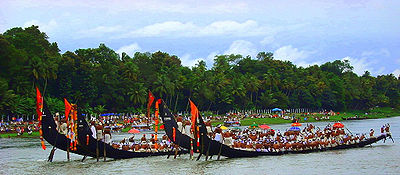
At Aranmula, during Onam days the famous Aranmula Vallam Kali is conducted.
The swing is another integral part of Onam, especially in the rural areas. Young men and women, decked in their best, sing Onappaattu, or Onam songs, and rock one another on swings slung from high branches.
Onam - Onam activities
The most important things about Onam are the onakkodi, the new dress worn on this day and onam sadhya, a feast which is quite elaborate. During Onam, people create a multi-colored floral decoration on the ground in the front of their home called a pookkalam. Young children are often entrusted with the task of gathering and laying out the flowers in elaborate patterns.
The Vallamkali (the snake boat race) is another event that is synonymous with Onam. Well-known races include the Aranmula Boat Race and the Nehru Trophy Boat Race. About 100 oarsmen row huge and graceful snake boats and men and women come from far and near to watch the snake boats skim through the water.
This festival is also important because of its secular character. Whatever might be the origin of Onam, today it is celebrated with equal fervour by the Hindus, Muslims and Christians, and hence it cannot be regarded as a Hindu festival in its strict sense.